Usage
Pathfinding in a graph
For this basic usage example, we’ll demonstrate how to perform pathfinding in the simplest environment: a directed graph.
First, we create a small weighted directed graph:
from w9_pathfinding.envs import Graph

graph = Graph(
    num_vertices=4,
    edges=[(0, 1, 2.0), (0, 2, 0.1), (1, 3), (2, 3)],  # [(start, end, weight), ...]
)
This graph looks like the following:
We want to find the optimal path from node 0 to node 3. Since the graph is weighted, we need to choose an algorithm that guarantees an optimal solution in such environments. One such algorithm is Dijkstra’s algorithm:
from w9_pathfinding.pf import Dijkstra

finder = Dijkstra(graph)
path = finder.find_path(0, 3)

print(path)  # [0, 2, 3]
print(graph.calculate_cost(path))  # 1.1
Pathfinding in a 2D grid
There are several types of environments in this library, and we can work with any of them. In this example, we’ll demonstrate how to perform pathfinding in a 2D grid environment.
First, let’s create a small grid with obstacles:
from w9_pathfinding.envs import Grid

grid = Grid(width=4, height=3)
grid.add_obstacle((1, 1))
grid.add_obstacle((2, 1))
This grid looks like the following:
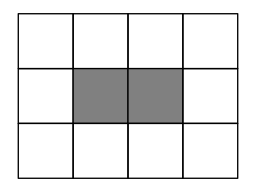
Now we want to find the optimal path from the top-left corner (0, 0) to the top-right corner (3, 0). We can use the same Dijkstra’s algorithm as we did for graphs. The syntax is nearly identical:
from w9_pathfinding.pf import Dijkstra

finder = Dijkstra(grid)
path = finder.find_path((0, 0), (3, 0))

print(path)  # [(0, 0), (1, 0), (2, 0), (3, 0)]
print(grid.calculate_cost(path))  # 3.0
By default, each cell in the grid has a movement cost (weight) of 1.0. So we currently have an unweighted grid where all cells are equally cheap. But we can increase the weight of a specific cell to make it less attractive for the pathfinder:
grid.update_weight((2, 0), 9.9)

path = finder.find_path((0, 0), (3, 0))

print(path)  # [(0, 0), (0, 1), (0, 2), (1, 2), (2, 2), (3, 2), (3, 1), (3, 0)]
print(grid.calculate_cost(path))  # 7.0
Now the algorithm chooses the bottom path. Even though it’s longer in terms of the number of steps, it’s cheaper in terms of the total cost.
Resumable Search
What if we want to find the optimal path from one node (start_node) to many other nodes? Sure, we could create a Dijkstra finder (or use any other pathfinding algorithm) and call find_path many times:
paths = []
for n in nodes:
    path = finder.find_path(start_node, n)
    paths.append(path)
But this would be inefficient, because each call would re-run the entire search from scratch.
Instead, we can use Resumable Search, which reuses intermediate results efficiently for multiple path queries from the same start node.
Depending on the environment, you can use one of the following:
ResumableBFS — for unweighted environments
ResumableDijkstra — for weighted environments
ResumableSpaceTimeDijkstra - for environments with dynamic obstacles
Let’s look at how to use ResumableDijkstra on a weighted grid:
from w9_pathfinding.envs import Grid
from w9_pathfinding.pf import ResumableDijkstra

grid = Grid(width=4, height=3)
grid.add_obstacle((1, 1))
grid.add_obstacle((2, 1))
grid.update_weight((2, 0), 1.5)

finder = ResumableDijkstra(grid, start_node=(0, 0))

nodes = [(3, 0), (3, 1), (3, 2)]
paths = []
for n in nodes:
    path = finder.find_path(n)
    paths.append(path)

print(paths[0])  # [(0, 0), (1, 0), (2, 0), (3, 0)]
print(paths[1])  # [(0, 0), (1, 0), (2, 0), (3, 0), (3, 1)]
print(paths[2])  # [(0, 0), (0, 1), (0, 2), (1, 2), (2, 2), (3, 2)]
Multi-Agent Pathfinding in a Graph
Multi-Agent Pathfinding (MAPF) is the problem of finding collision-free paths for multiple agents moving simultaneously in a shared environment.
Let’s create a simple graph environment for two agents:
from w9_pathfinding.envs import Graph

graph = Graph(num_vertices=5, edges=[(0, 2), (1, 2), (2, 3), (2, 4)])
We have two agents:
Agent 1 starts at node 0 and wants to move to node 3.
Agent 2 starts at node 1 and wants to move to node 4.
We can use the CBS algorithm to find collision-free paths:
from w9_pathfinding.mapf import CBS

finder = CBS(graph)
paths = finder.mapf(starts=[0, 1], goals=[3, 4])
print(paths)  # []
We get an empty list, which means that CBS was unable to find a collision-free solution. The reason is that on the first step, both agents can only move to node 2, leading to an unavoidable collision.
The agents can’t perform a wait (pause) action at their start positions, because in the Graph environment, waiting requires explicit self-loops.
So let’s add self-loops to help our agents:
graph.add_edges([(0, 0, 0.5), (1, 1, 2)])
Now the agents can wait if necessary, and we should be able to find a valid solution:
paths = finder.mapf(starts=[0, 1], goals=[3, 4])
print(paths)  # [[0, 0, 2, 3], [1, 2, 4]]
Note that Agent 1 waits in place at the first step while Agent 2 moves. It’s not the other way around because the pause action for Agent 1 is cheaper than for Agent 2. And since CBS is an optimal algorithm, it selects the solution with the lowest total cost.
Multi-Agent Pathfinding in a Hex Grid
In a Grid environment, agents can pause (i.e., wait in place) at any cell by default, with a pause cost of 1.0. However, this behavior is fully customizable — you can:
Make certain cells impassable
Set different pause costs per cell
Disallow pause actions entirely for specific cell
Let’s explore how this works using a Hexagonal Grid, with custom cell weights and pause costs. As a result we’ll try to find a collision-free plan for multiple agents.
from w9_pathfinding.envs import HexGrid, HexLayout
from w9_pathfinding.mapf import CBS

# Cost to enter each cell (-1 = impassable)
weights = [
    [1, 1, -1, 1.2, 1.2, 1, 1],
    [1, 1, -1, 1.2, 1.2, 1, 1],
    [1, 1, -1, -1, 1, 1, 1],
    [1, 1, 1, 1, 1, 1, 1],
    [1, 1, -1, -1, -1, 1, 1],
]

# Cost of waiting at each cell (with the same shape as weights)
pause_weights = [
    [1, 1, 1, 0.1, 0.1, 1, 1],
    [1, 1, 1, 0.1, 0.1, 1, 1],
    [1, 1, 1, 1, 1, 1, 1],
    [1, 1, 1, 1, 1, 1, 1],
    [1, 1, 1, 1, 1, 1, 1],
]

# Create a grid
grid = HexGrid(
    weights=weights,
    pause_weights=pause_weights,
    edge_collision=True,
    layout=HexLayout.odd_r,
)

# Define start and goal positions for 6 agents
starts = ((1, 0), (1, 2), (1, 4), (5, 0), (5, 2), (5, 4))
goals = ((6, 0), (6, 2), (6, 4), (0, 0), (0, 2), (0, 4))

# Solve the mapf problem
finder = CBS(grid)
paths = finder.mapf(starts, goals)
The result:
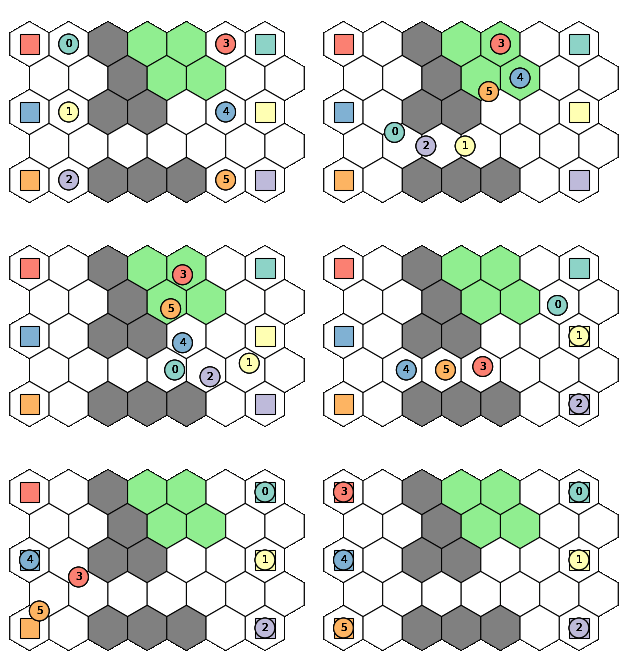
In this visualization:
Gray cells are impassable (weight = -1)
White cells are normal traversable cells (weight = 1, pause_weight = 1)
Light green cells are “waiting zones” (weight = 1.2, pause_weight = 0.1)
Because the pause cost is lower in waiting zones, agents prefer to wait there when needed. This helps minimize the total travel cost.
Pathfinding with dynamic obstacles
To manage dynamic obstacles in pathfinding, a ReservationTable can be used. This data structure tracks the availability of each cell or edge over time, indicating whether it is free or reserved. In the case of the single-agent pathfinding problem with dynamic obstacles, there is a specialized version of the A* algorithm known as Space-Time A*.
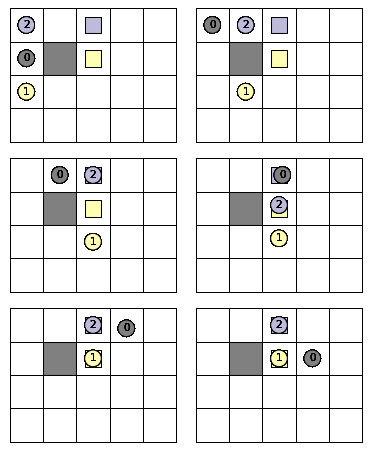
Let’s look at a simple example. We have three agents: Agent 0, Agent 1, and Agent 2. Agent 0 has a predetermined path that we cannot change, this agent acts as a dynamic obstacle. Agents 1 and 2 each have a starting point and a destination, and we want to find paths for both agents while ensuring they do not collide with each other or with Agent 0. We can achieve this by calling Space-Time A* twice, updating the ReservationTable between the calls:
from w9_pathfinding.envs import Grid
from w9_pathfinding.mapf import SpaceTimeAStar, ReservationTable

grid = Grid(width=5, height=4, edge_collision=True)
grid.add_obstacle((1, 1))  # static obstacle

path0 = [(0, 1), (0, 0), (1, 0), (2, 0), (3, 0), (3, 1)]  # dynamic obstacle
start1, goal1 = (0, 2), (2, 1)  # agent 1
start2, goal2 = (0, 0), (2, 0)  # agent 2

rt = ReservationTable(grid)
rt.add_path(path0, reserve_destination=True)

astar = SpaceTimeAStar(grid)

path1 = astar.find_path(start1, goal1, reservation_table=rt)
rt.add_path(path1, reserve_destination=True)

path2 = astar.find_path(start2, goal2, reservation_table=rt)

print(path1)  # [(0, 2), (1, 2), (2, 2), (2, 1)]
print(path2)  # [(0, 0), (1, 0), (2, 0), (3, 0), (4, 0), (3, 0), (2, 0)]
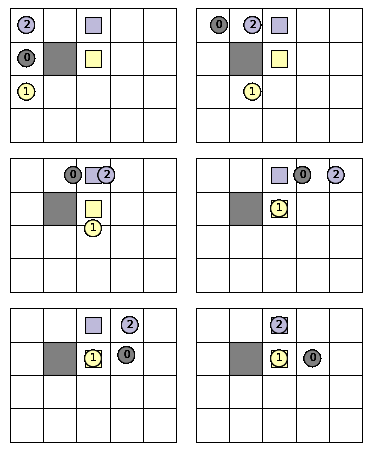
This approach works quickly and often finds reasonably good solutions. However, in some cases, it may find solutions that are far from optimal or may not find a solution at all, when one agent prevents any path for another agent. An alternative approach is to use Multi-Agent Pathfinding (MAPF) algorithms, which allow us to find paths for both agents simultaneously. Since all MAPF algorithms in this repository are designed to work with the ReservationTable, we can find an optimal solution while taking dynamic obstacles into account:
from w9_pathfinding.mapf import CBS

rt = ReservationTable(grid)
rt.add_path(path0, reserve_destination=True)

cbs = CBS(grid)
paths = cbs.mapf([start1, start2], [goal1, goal2], reservation_table=rt)

print(paths[0])  # [(0, 2), (1, 2), (2, 2), (2, 2), (2, 1)]
print(paths[1])  # [(0, 0), (1, 0), (2, 0), (2, 1), (2, 0)]